Chosen by Umika
Kinjohro
Ryokan and ryōtei (traditional kaiseki restaurant) founded in 1890, 6 rooms · Kanazawa and Kaga Onsen
Kinjohro is a ryōtei (traditional restaurant) and ryokan (Japanese inn) founded in 1890 in Kanazawa, close to the Higashi Chaya and Kazue-machi teahouse districts. It has 6 Japanese-style rooms, each with a private hinoki (Japanese cypress) or granite bath, and serves Kaga-style kaiseki (multi-course dinner) in the room or a private dining room. Its garden belonged to the former residence of Maeda Tsushima-no-kami.
RyokansFood and gastronomy
from 931 € per night
Take-no-ma room (100 m², two Japanese-style rooms), 2 adults, room only, free cancellation until 5 April 2027 (¥165,000 a night), 2-night stay from 13 April 2027. Indicative price, taxes included, to be confirmed with your request.
Public price collected on: site officiel (kinjohro.co.jp, réservation tripla) — accessed 30 October 2026
A travel advisor replies by email. Free, no commitment.
Kinjohro is a Kanazawa house founded in 1890, both a ryōtei (a traditional restaurant where meals are served in private rooms) and a ryokan (Japanese inn), with six Japanese-style rooms by the Asano River, the starting point for walks to the Kazue-machi and Higashi Chaya teahouse districts. It suits couples who come to Kanazawa first for the food: Kaga-style kaiseki is served in the room or a private dining room, and in the evening you walk back from the teahouse quarters.
A restaurant with rooms
Kinjohro is first of all a kaiseki restaurant (kaiseki being a Japanese meal of many small seasonal courses) serving the cuisine of Kaga, the former domain of the Maeda lords, whose capital was Kanazawa. The rooms extend the meal: kaiseki dinner and breakfast are served in the room or in a private dining room, never in a shared hall. Tea is served on arrival, and drinks from the room's fridge are included.
Stays can be booked room only, with breakfast, or with the Kaga kaiseki dinner; a crab kaiseki menu is offered on some dates. Prices shown on the house's booking engine include consumption tax and service.
The house keeps its history: the garden is that of the former residence of Maeda Tsushima-no-kami almost unchanged for more than 150 years, and the Fuji-an annex was built for the enthronement of Emperor Shōwa.
Six rooms, six ways to sleep
All rooms are Japanese-style, with tatami floors (rice-straw mats) and a private bathroom with a bidet toilet. What changes from one to the next is the bedding, the view and the bath material. The sizes below are those given by the house's booking engine.
- Take no Ma (100 m²): the largest, with two rooms of 15 and 8 tatami mats, futons (mattresses laid on the floor), a private bath in natural red granite and a view of a small inner garden around the Gesshō stone. The hanging scroll changes with the seasons.
- Yuki no Ma and Tsuki no Ma (92 m² each): both look onto the historic garden. Yuki no Ma has a 13-tatami room and a bedroom with beds; Tsuki no Ma has two rooms of 12 and 11 tatami and you sleep on futons.
- Fuji no Ma and Kiku no Ma (62 m² each): the two 3rd-floor rooms, built in May 2015, with a Japanese room, a bedroom with beds and a study corner; bath made entirely of hinoki (Japanese cypress). Fuji no Ma looks onto a garden laid out on that floor. They can be booked together to have the whole floor, an option for a family or friends.
- Hana no Ma (46 m²): a single 10-tatami room over the historic garden, futons and a hinoki bath; the simplest in the house.
If you prefer a bed, choose Yuki no Ma, Fuji no Ma or Kiku no Ma; for futons and the most space, Take no Ma or Tsuki no Ma. For three or more guests, the rooms with beds add futons.
The house has no hot spring: each room has its own private bath with ordinary water.
An accessible house
Kinjohro has a lift and step-free rooms, and lends a wheelchair. It is certified by the Japan Tourism Agency for accessible hospitality. There is free parking for 10 cars.
Check-in is from 4 pm, last arrival 7 pm, and check-out is at 11 am.
On foot through Kanazawa's teahouse quarters
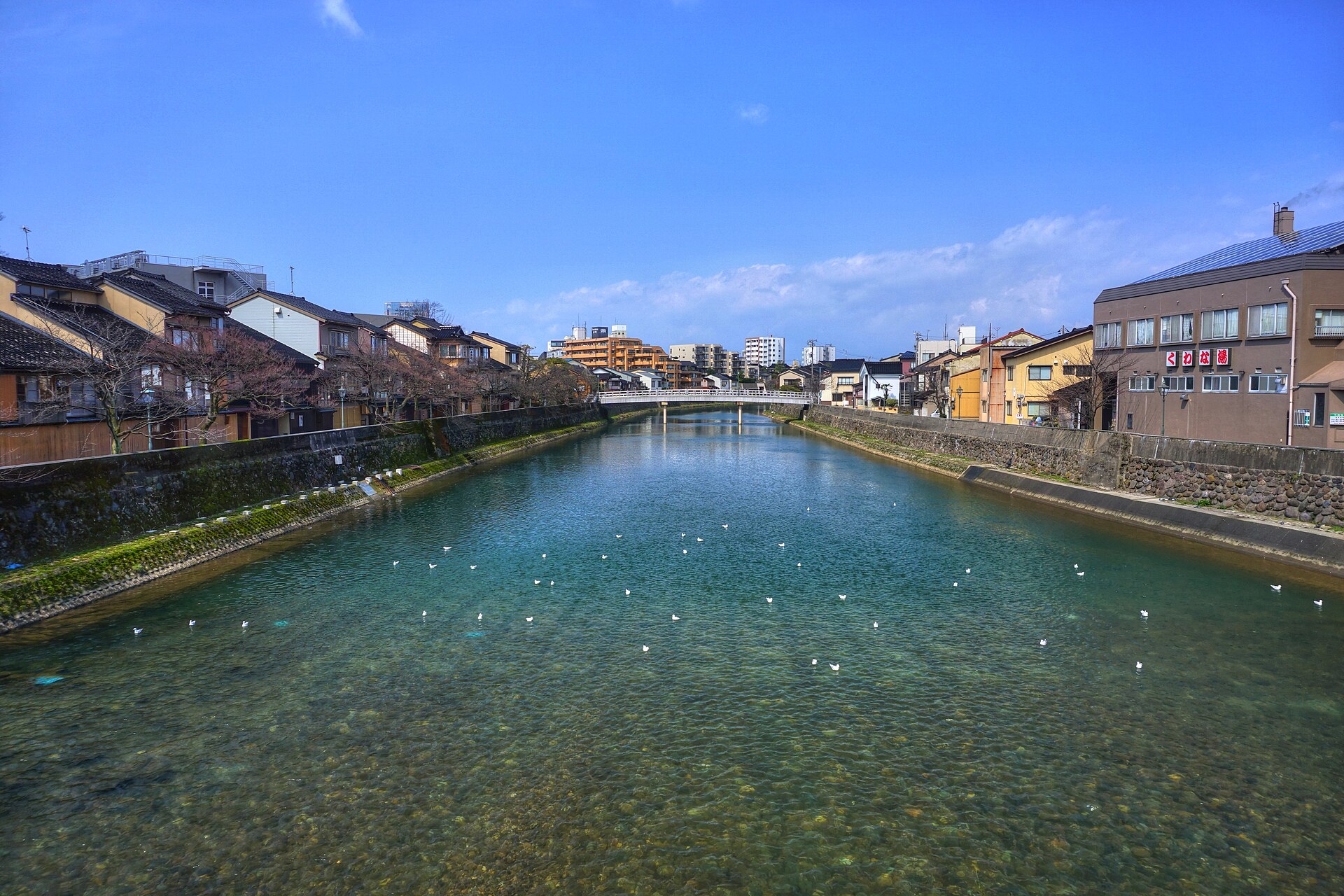
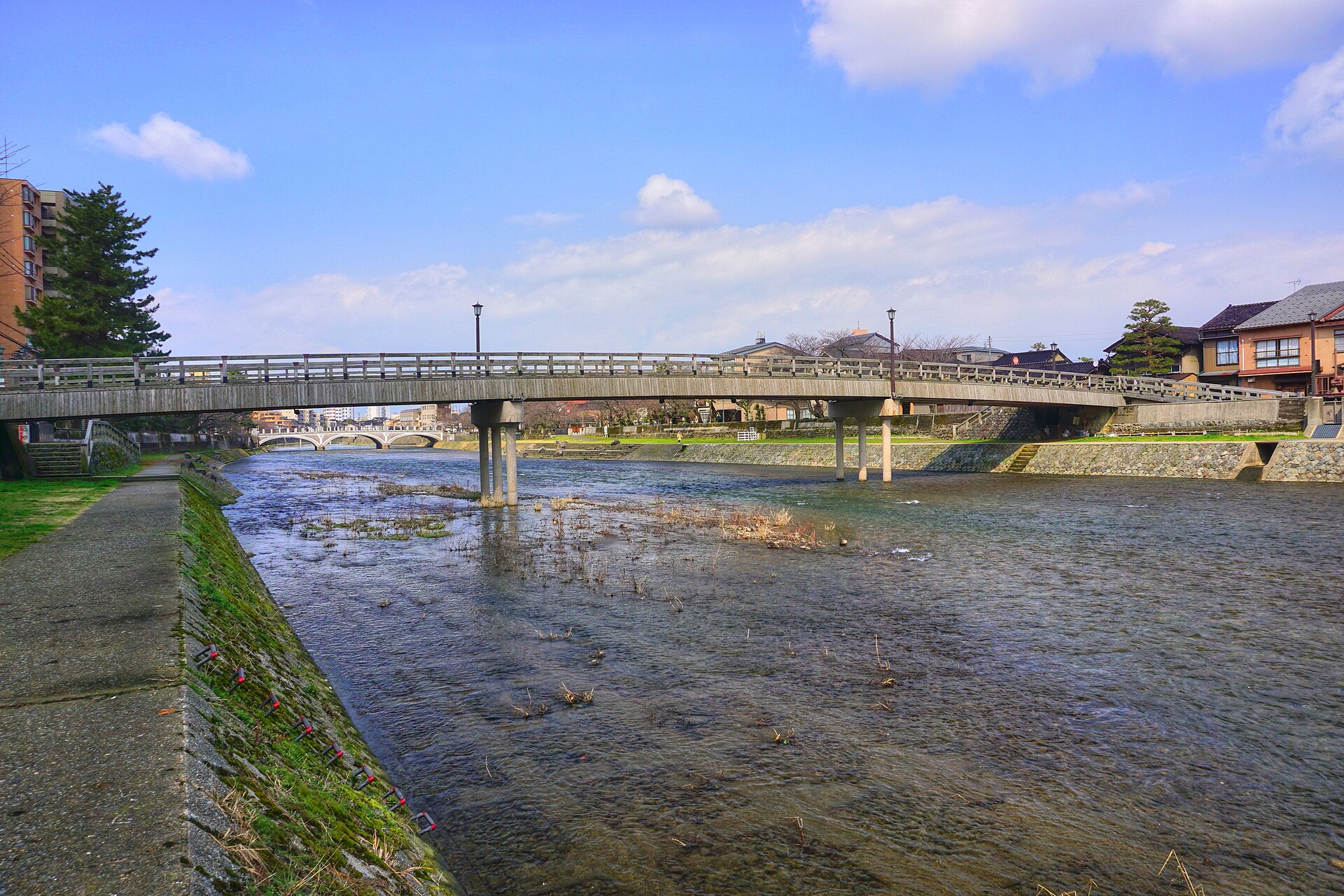
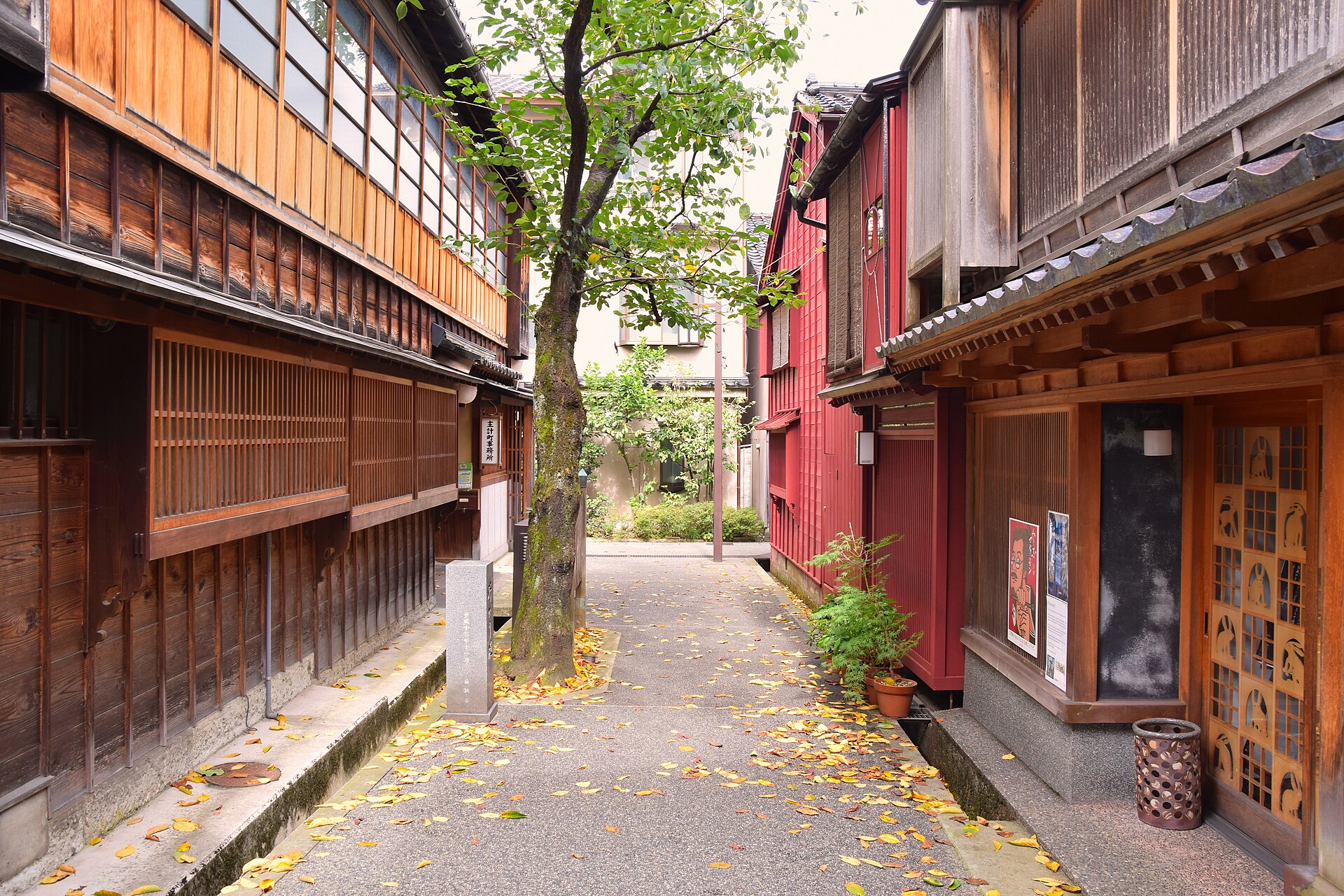
The house is at 2-23 Hashiba-chō, by the Asano River, the starting point for walks to Kazue-machi and Higashi Chaya, the chaya districts (wooden teahouses where geiko, Kanazawa's traditional entertainers, perform). On Saturdays from May 2026 to March 2027, the Kanazawa tourist office runs a geiko performance of about an hour in a teahouse in the Higashi, Nishi or Kazue-machi district, with tea and a sweet, for 5,000 ¥ (about 29 €) per person.
Kenrokuen garden is a walk or short taxi ride away; it opens 7 am to 6 pm from 1 March to 15 October and 8 am to 5 pm the rest of the year. The 21st Century Museum of Contemporary Art will be closed from 6 May 2027 to March 2028, so plan a visit before May 2027 if it matters to you.
From Kanazawa Station, the Hokuriku Railroad bus leaves the East Exit (stop 6) and stops at Hashiba-chō, outside the door, in 12 minutes. Kanazawa is about 2 hours 30 from Tokyo on the Hokuriku Shinkansen (bullet train). The city and its surroundings are covered on our Kanazawa and Kaga Onsen page, and the Japanese Alps and Kanazawa in 10 days itinerary spends three nights here.
Kinjohro or a Kaga hot spring ryokan
In our selection, Kinjohro is the only address in the city: you stay for the food and for evening walks in the teahouse districts. The other two are in Yamashiro Onsen, 15 minutes from Kanazawa by Shinkansen to Kaga-Onsen and then by car: Beniya Mukayu, 16 rooms each with a private open-air hot spring bath, and KAI Kaga, 48 rooms in the middle of the spa town. A stay in the region often pairs two nights at Kinjohro with one or two in Kaga for the baths.
Room types
| Room | View | Bed |
|---|---|---|
| Take no Ma | small inner garden, Gesshō stone | futons |
DetailsWho it suits: Couples who want the largest tatami room, with futons. Bathroom: private bath in natural red granite, bidet toilet Highlights: two Japanese rooms of 15 and 8 tatami mats; hanging scroll changed with the seasons | ||
| Fuji no Ma | garden laid out on the 3rd floor | beds with duvets; futons for 3 or more guests |
DetailsWho it suits: Couples who prefer a bed; families or friends booking the whole 3rd floor with Kiku no Ma. Bathroom: private bath made entirely of hinoki (Japanese cypress), bidet toilet Highlights: 12-tatami Japanese room and Western bedroom, study corner; built in May 2015; on the 3rd floor, bookable with Kiku no Ma as a private floor | ||
| Kiku no Ma | beds with duvets; futons for 3 or more guests | |
DetailsWho it suits: Couples who prefer a bed, in a recently built room. Bathroom: private bath made entirely of hinoki (Japanese cypress), bidet toilet Highlights: 10-tatami Japanese room with tokonoma alcove and Western bedroom, sloping ceiling, study corner; built in May 2015; on the 3rd floor | ||
| Yuki no Ma | garden of the former residence of Maeda Tsushima-no-kami | beds with duvets; futons for 3 or more guests |
DetailsWho it suits: Couples who want a bed and a view of the historic garden. Bathroom: private bath made entirely of hinoki (Japanese cypress), bidet toilet Highlights: 13-tatami Japanese room and bedroom with beds | ||
| Tsuki no Ma | garden of the former residence of Maeda Tsushima-no-kami | futons |
DetailsWho it suits: Couples or families who want to sleep on futons facing the historic garden. Bathroom: private bath made entirely of hinoki (Japanese cypress), bidet toilet Highlights: two Japanese rooms of 12 and 11 tatami mats, both facing the garden | ||
| Hana no Ma | garden of the former residence of Maeda Tsushima-no-kami | futons |
DetailsWho it suits: Couples happy with a single room, the simplest in the house. Bathroom: private bath made entirely of hinoki (Japanese cypress), bidet toilet Highlights: one 10-tatami Japanese room | ||
Source: Kinjohro, ご宿泊 (hébergement, site officiel en japonais) — accessed 30 October 2026
Restaurants
Kinjohro (kaiseki, Kaga cuisine)
Facilities
- 6 Japanese-style rooms, all with a private bathroom (hinoki or red granite bath)
- Kaiseki dinner and breakfast served in the room or a private dining room; tea served on arrival; minibar drinks included
- House founded in 1890; garden of the former residence of Maeda Tsushima-no-kami, almost unchanged for over 150 years; Fuji-an annex built for Emperor Shōwa's enthronement
- Check-in from 4 pm (last check-in 7 pm), check-out 11 am
- Lift, step-free rooms, wheelchair loan; certified by the Japan Tourism Agency for accessible hospitality; free parking for 10 cars
Location
2-23 Hashiba-chō, Kanazawa, by the Asano River, a starting point for walks to the Kazue-machi and Higashi Chaya teahouse districts. From Kanazawa Station East Exit (stop 6), Hokuriku Railroad bus to the Hashiba-chō stop, in front of the inn: 12 minutes.
Map drawn by Umika from OpenStreetMap data, © OpenStreetMap
| From the hotel | On foot | By car |
|---|---|---|
| Hashiba-chō bus stop | — | 0.0 km |
| Kazue-machi | 9 min (0.6 km) | 0.3 km |
| Higashi Chaya | 13 min (0.9 km) | 0.5 km |
| Kanazawa Station (Shinkansen) | 27 min (2.0 km) | 2.2 km |
| Kenrokuen garden | 15 min (1.1 km) | 1.3 km |
Shortest routes calculated by OSRM (routing.openstreetmap.de) on OpenStreetMap data, on 31 October 2026.
Guest reviews
4,4/5 — 282 reviews
Rating published by a travel website. Verified reviews from Umika travellers will appear here after their first trips.
Source: Google — accessed 30 October 2026
Trip ideas with this hotel
Best months to go
Read next
- When to go to Japan: cherry blossoms, rainy season, typhoons and autumn leaves
- Onsen, ryokan and etiquette in Japan: bathing, tattoos, temples and dining
- Kanazawa, Shirakawa-go and Takayama in 10 days
- KAI Kaga
- Beniya Mukayu
- Trains in Japan: shinkansen, Japan Rail Pass, seat reservations and IC cards
- Japan entry requirements: passport, Visit Japan Web, medicines and customs
- Money in Japan: yen, cash machines, tax-free shopping and accommodation taxes
Frequently asked questions
Where is Kinjohro?
At 2-23 Hashiba-chō in Kanazawa, by the Asano River, on the way to the Kazue-machi and Higashi Chaya teahouse districts. The Hokuriku Railroad bus takes 12 minutes from Kanazawa Station East Exit to the Hashiba-chō stop, outside the house.
Do the rooms have private bathrooms?
Yes. All six rooms have a private bath, in hinoki in five of them and in red granite in Take no Ma, with a bidet toilet. The house has no hot spring and no shared bath.
Can we sleep in a bed?
Yes, in Yuki no Ma, Fuji no Ma and Kiku no Ma, which have a bedroom with beds as well as the tatami room. Take no Ma, Tsuki no Ma and Hana no Ma are futon rooms.
Where are meals served?
The Kaga kaiseki dinner and breakfast are served in the room or in a private dining room. Rooms can also be booked without meals or with breakfast only.
Is Kinjohro wheelchair accessible?
Yes. The house has a lift and step-free rooms, lends a wheelchair and is certified by the Japan Tourism Agency for accessible hospitality.
A travel advisor replies by email. Free, no commitment.